

Challenge 1: Exosomes Biological Safety and Efficacy
The therapeutic efficacy of exosomes depends on the cell source, type, parental cell state, surface components, and internal cargo. The surface components and cargo reflect their origin, making them uniquely suited for specific therapeutic applications.
Among exosomes for regenerative purposes, we can find:
- Autologous exosomes: derived from the recipient’s cells.
- Non-autologous exosomes: include allogenic exosomes (exosomes derived from different individuals of the same recipient species) and xenogeneic exosomes (exosomes derived from species other than that of the recipient).
Not all of them have the same therapeutic potential and safety profile. The recipient’s cell receptors recognize autologous exosomes with regenerative potential as integrant of their regenerative system. However, non-autologous exosomes can be rejected and destroyed by the recipient’s immune system without participating in the regenerative process. Furthermore, unlike non-autologous exosomes, autologous exosomes are fully compatible with the recipient and cannot induce:
- Immune responses
- Disease transmission
- Cross- or intra-species contamination
This fact associates autologous exosomes with no side effects.
Many products on the cosmetic market claim to contain exosomes sourced from newborn cells, with the subliminal message, and without scientific evidence, that the donor’s age matters regarding the quality and efficacy of exosomes. Some studies have found inconsistent results regarding the number of exosomes released and age. Since these exosome-containing products are classified as cosmetics, they cannot be injected, which limits their application to the stratum corneum and epidermis without reaching the dermis, where the regenerative process occurs. Furthermore, as they do not contain exosomes derived from the recipient’s cell, they have the same limitations as non-autologous exosomes (no immune compatibility, disease transmission risk, and poor safety and efficacy profiles).
The long-term effects of the negligent use of cosmetics as injectable treatments are unknown, and the consequences are still unknown.
Challenge 2: Exosomes Quantification, Viability, Administration, and Effective Dose
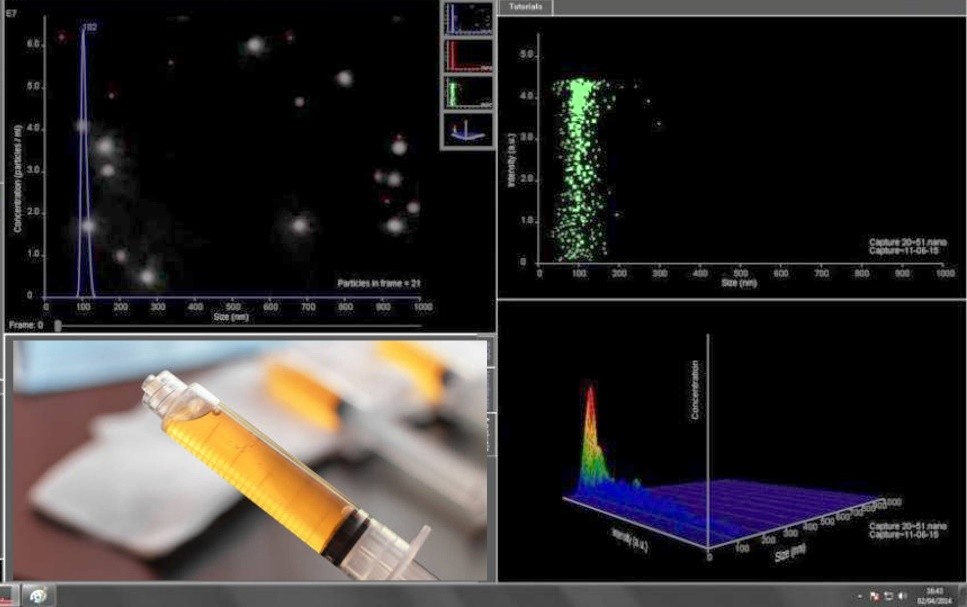
Currently, the concentration of exosome products is generally measured using the number of exosome particles and the size distribution, which determines their consistency and purity (based on the number of particles per microgram of protein [particles/ug]). Several methods measure exosome size distribution and/or particle concentration. These techniques include Nanoparticle Tracking Analysis (NTA), Dynamic Light Scattering (DLS), Tunable Resistive Pulse Sensing (TRPS), Single-Particle Interferometric Reflectance Imaging Sensing (SP-IRIS), Flow cytometry, and electron microscope photography (TEM/cryo-EM). However, the results from different particle size and concentration measurement methods can vary significantly.
Regarding purity, it is essential to note that exosome products often contain an unknown amount of exosome content and contaminants that may include proteins, cell-free DNA, viruses, and vesicles of other origins. Given the complexity of purifying these samples, it is essential to implement more rigorous controls to ensure the safety and efficacy of any approved therapies.
Other relevant aspects to be considered are the lability of the bioactive components of exosomes (proteins/RNAs). Standardizing preparation methods and storage conditions is crucial to preserving their viability and effective dose. Local delivery doses may vary, and approximately one trillion exosomes might be needed for systemic exosome treatments in humans. Furthermore, the administration route is pivotal in the exosome’s biodistribution and, consequently, in their therapeutic outcomes.
Exosomes’ cosmetics must be topically applied; thus, they cannot reach the deeper skin layers where the regenerative processes occur.
Challenge 3: Exosomes Regulatory Compliance
Despite the significant progress we have seen in their biology and applications, exosome capabilities have yet to be fully harnessed for any potential commercial use. The analysis and manufacturing of exosome-based products need to be standardized for clinical applications, and to date, there is no consensus on the isolation methods and release criteria.
Most exosome therapeutics are undergoing Phase I clinical trials, with a few subjects receiving an escalating dose to identify potential adverse effects. Despite the growing acceptance of the safety of exosomes in humans, more comprehensive clinical protocols are still required to initiate Phase II clinical trials, which will assess the efficacy of exosomes in a larger population. By now, the only products, including exosomes, that can be used for injected regenerative therapies are autologous products such as platelet-rich plasma or adipose-derived mesenchymal cells containing naïve autologous exosomes (unmodified exosomes naturally produced by cells).
So far, no exosome-based injectable products for therapeutic use have been approved by regulatory bodies, such as the Food and Drug Administration (FDA), European Medicines Agency (EMA), or Japan’s Pharmaceuticals and Medical Devices Agency (PMDA).

