
MCT System
Photothermal biomodulation.
One step beyond cells.
MCT Unit and MCT Kit: two certified medical devices that apply controlled light and temperature to the patient’s own biological material, at the point of care.
Why the MCT System
What makes the MCT System different?
Autologous
Works with the patient’s own platelet-rich plasma (PRP), processed at the point of care.
Controlled process
Each preset defines specific light wavelength, temperature and exposure time parameters to ensure controlled and standardized processing conditions.
Photothermal biomodulation
Specific wavelengths of light combined with controlled temperature, applied inside a single-use MCT Kit.
The system
Two devices. One system.
MCT Unit applies the light and the temperature. MCT Kit holds the autologous preparation while it is conditioned.
Device 01
MCT Unit®
The MCT Unit delivers photothermal conditioning through predefined protocols combining specific light wavelengths, temperatures and exposure times.
Device 02
MCT Kit®
A patented, single-use cassette in medical-grade polymer, designed for light and thermal transmission. It holds up to 10 mL of autologous preparation.
Presets
One system, three presets.
Each preset uses predefined light wavelengths, exposure times and, where applicable, temperature settings to condition autologous PRP.
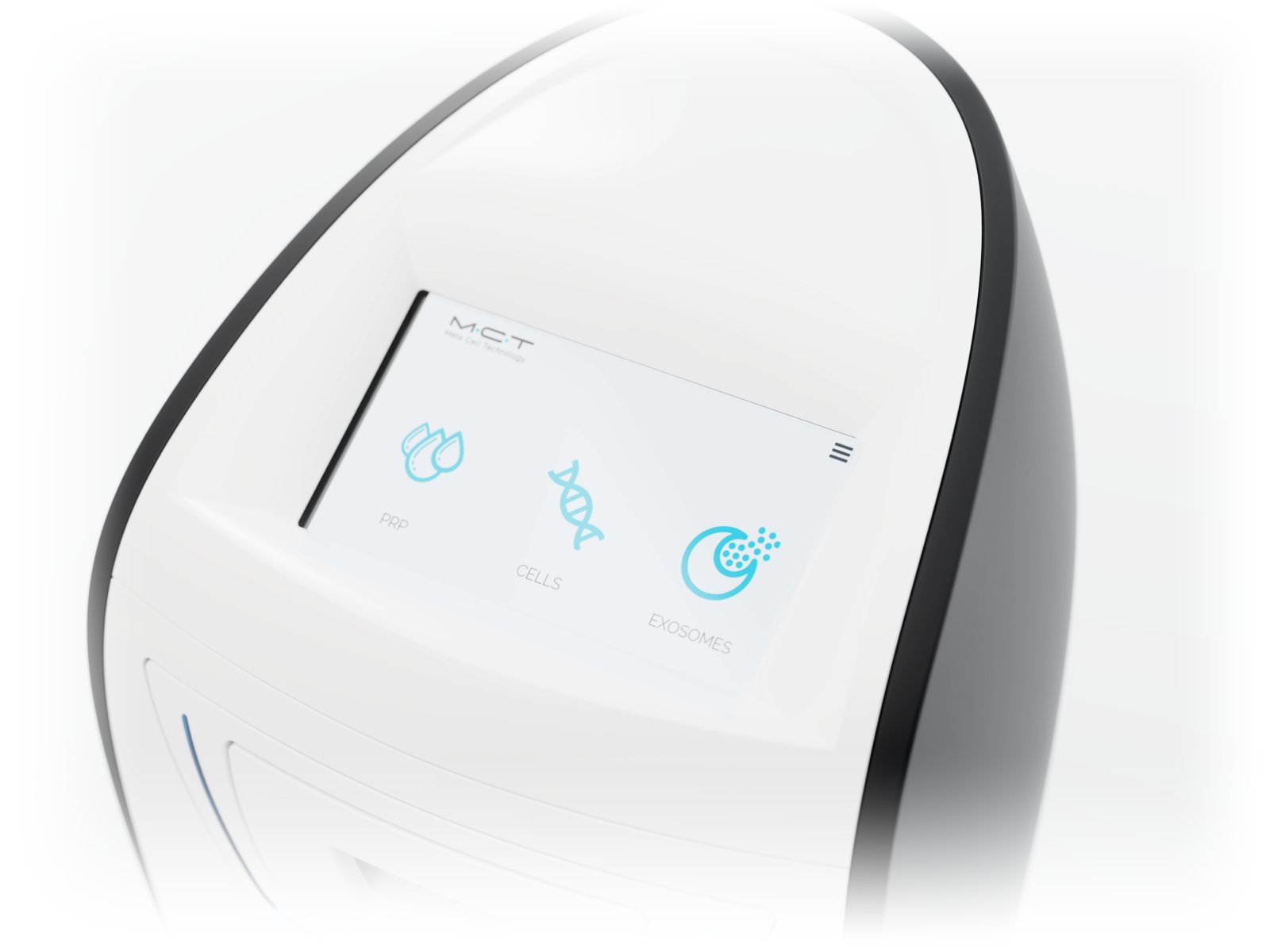
PRP
MCT Plasma
Combines red light and controlled cooling (4 °C) to prime platelets in PRP, modulating growth factor release.
CELLS
MCT Cells
Combines red and near-infrared light through a predefined photobiomodulation protocol, with specific wavelengths, fluences and exposure times to ensure controlled and reproducible light exposure.
EXOSOMES
MCT Exosomes
Combines blue light and controlled temperature (37 °C) to stimulate the release of exosomes from the patient’s own platelets, obtaining an autologous PRP enriched with platelet-derived exosomes.
Add-on
Exo-Tech
An add-on to the MCT Exosomes protocol that combines autologous plasma gel with PRP enriched with platelet-derived exosomes, creating an injectable autologous matrix.
The technology
Photothermal biomodulation
Two physical stimuli, light and temperature, applied under controlled conditions to the patient’s own PRP inside the MCT Kit.
Increased levels of growth factors
Photothermal biomodulation primes platelets before clinical application. Studies have reported increased levels of selected growth factors following PRP conditioning, while platelet priming may also influence their release kinetics over time.
Enhanced ATP production
Light at specific wavelengths can interact with mitochondrial photoacceptors, influencing cellular energy metabolism and ATP production.
Regenerative potential across therapeutic areas
Published clinical studies have reported promising findings with photothermally conditioned PRP across different therapeutic areas, supporting its potential in regenerative medicine.
Improved platelet performance
The MCT System photothermally conditions previously prepared PRP to prime platelets. It complements the PRP preparation process through predefined light and temperature protocols.
MCT Academy
Backed by published research
Scientific publications and expert webinars on photothermal biomodulation, from bench to clinical practice.
Molecular mechanisms of the geroprotective effect of exosomes in the simulation of inflammaging in the culture of human fibroblasts
Molecular mechanisms of the geroprotective effect of exosomes in the simulation of inflammaging in the culture of human fibroblasts
A Reliability Tier Classification System (RTCS) for Marketed Exosome-Based Products to Facilitate Clinical Decision-Making
A Reliability Tier Classification System (RTCS) for Marketed Exosome-Based Products to Facilitate Clinical Decision-Making
Protocol for ex vivo physicochemical assessment of photothermally preconditioned platelet-rich plasma
Protocol for ex vivo physicochemical assessment of photothermally preconditioned platelet-rich plasma
Workflow
The MCT System protocol
A controlled three-step process at the point of care.
01
Obtain autologous PRP
Collect the patient’s blood and prepare PRP using the selected PRP preparation system, following the manufacturer’s instructions.

02
Load the MCT Kit®
Transfer up to 10 mL of prepared PRP into the single-use MCT Kit.

03
Run the preset on the MCT Unit®
Select the appropriate preset according to the desired biologic effect. The MCT Unit automatically applies the predefined light and temperature settings for photothermal conditioning.
Clinical areas
One system, multiple medical specialties.
PRP is used across diverse clinical applications. The MCT System introduces an innovative approach to PRP through controlled photothermal conditioning, supported by scientific and clinical evidence.

Orthopedics & Sports Medicine
Osteoarthritis, tendinopathies and musculoskeletal injuries.

Clinical dermatology
Chronic and acute wounds, tissue repair, burns and post-surgical recovery.

Trichology
Androgenetic alopecia, alopecia areata and seborrheic dermatitis.

Aesthetic medicine
Skin quality improvement, scar management and pigmentation disorders.
Contact
Talk to our team
Tell us about your practice or distribution network, and our team will get back to you.

